> For the complete documentation index, see [llms.txt](https://docs-vnext.kiflo.com/llms.txt). Markdown versions of documentation pages are available by appending `.md` to page URLs; this page is available as [Markdown](https://docs-vnext.kiflo.com/leads-deals/submission-forms/customize-the-lead-submission-form.md).
# How to customize the Lead Submission Form?
You will need to customize the lead form in order to gather more precise information on your leads. The lead form will also guide your partners on the information you expect them to gather on potential leads.
#### In this article
* [How to customize the lead form?](#how-to-customize-the-lead-form)
* [What are the best practices for lead forms?](#what-are-the-best-practices-for-lead-forms)
## How to customize the lead form?
Here is a step to step guide to customize your lead form:
* On Kiflo click on the top right-hand corner on your name
* Click on **Account**

* On Account, go to **Properties** and the **Leads** tab

On this page, you can add or delete properties attached to each lead. These fields will be shown on each lead but also on your partner's lead form and personal lead form. You can choose specific permissions and behaviors for each property.
## What are the best practices for lead forms?
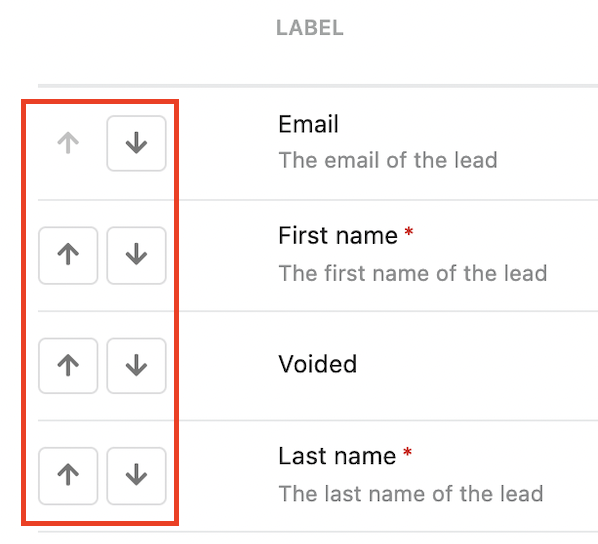
* Place required lead properties on top of a leads form
* this will ensure your partners enter the required details first as a priority and know what you expect of them. In order to place properties on the form in a certain order please see the screenshot below:
* Keep the lead form simple
* By simple we mean keep the list of properties you expect from your partners on a lead short and also properties that are easy to attain from people.
* Choose the correct "Type" when creating properties
* This will ensure your partners enter the correct data and in the correct format. When you create a new property you can choose a type.
* Adding a Placeholder when creating properties
* These will guide your partners on the expected answer. When you create a new property you can add a placeholder.
---
# Agent Instructions
This documentation is published with GitBook. GitBook is the documentation platform designed so that both humans and AI agents can read, navigate, and reason over technical content effectively. Learn more at gitbook.com.
## Querying This Documentation
If you need additional information that is not directly available in this page, you can query the documentation dynamically by asking a question.
Perform an HTTP GET request on the current page URL with the `ask` query parameter, and the optional `goal` query parameter:
```
GET https://docs-vnext.kiflo.com/leads-deals/submission-forms/customize-the-lead-submission-form.md?ask=&goal=
```
`ask` is the immediate question: it should be specific, self-contained, and written in natural language.
`goal` is optional and describes the broader end goal you are ultimately trying to accomplish on behalf of the user. GitBook uses it to tailor the answer towards what is most useful for that goal.
The response will contain a direct answer to the question and relevant excerpts and sources from the documentation.
Use this mechanism when the answer is not explicitly present in the current page, you need clarification or additional context, or you want to retrieve related documentation sections.